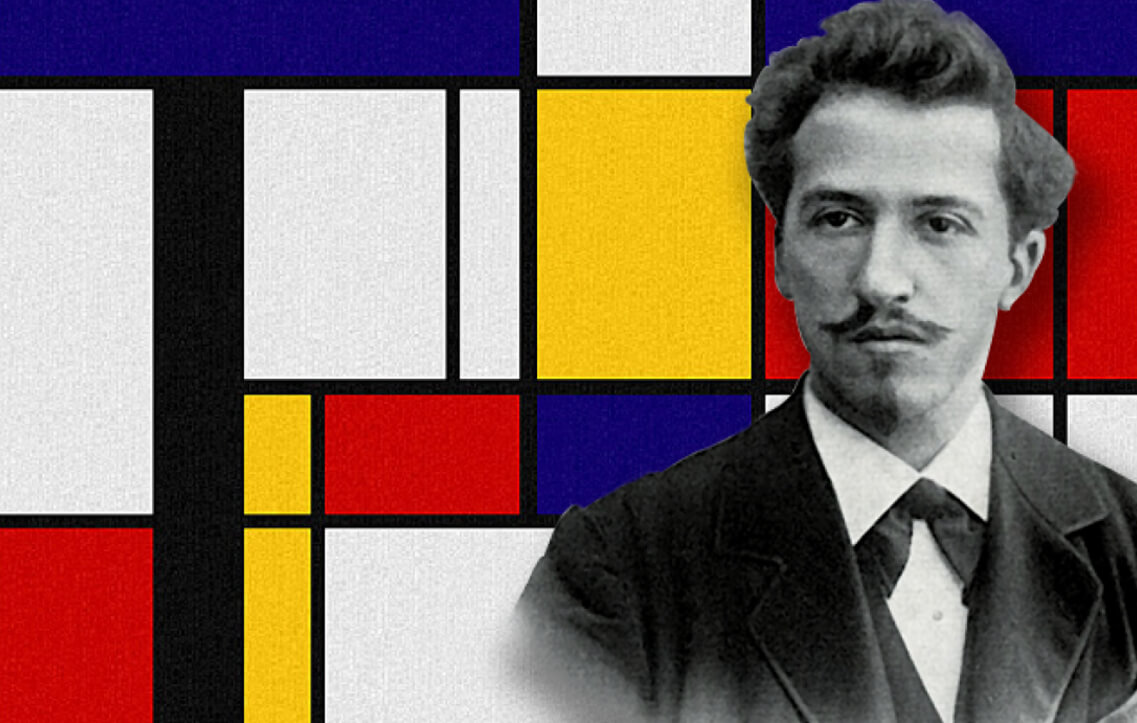
Piet Mondrian is an artist who transformed the way we understand abstraction. Born in 1872 in the Netherlands, he dedicated his life to discovering visual balance — pure, structured, and mathematically precise. Today, Mondrian is known for his iconic compositions of straight lines, primary colors, and geometric harmony, but behind this simplicity lies a powerful artistic philosophy.
From Realism to Pure Abstraction
Mondrian’s early works featured natural landscapes, trees, and serene rural scenes. Over time, he slowly stripped away detail, moving from recognizable shapes to a new visual language based solely on structure and balance.
The Influence of Theosophy
Deeply inspired by theosophical ideas, Mondrian believed in a hidden universal order — and he aimed to express it through art. This pursuit of harmony shaped his entire career.
The De Stijl Movement
In 1917, together with Theo van Doesburg, Mondrian co-founded the De Stijl movement.
De Stijl embraced minimalism, purity, and abstraction through vertical and horizontal lines, primary colors, and a strict, balanced aesthetic.
Mondrian believed that art should reveal the underlying order of reality — not through objects, but through the relationship between color, line, and space.
The “Compositions” – A Visual Revolution
His most famous works, the “Composition” series, feature grids, rectangles, and primary colors.
These paintings became emblematic of modernism, influencing:
- architecture
- fashion
- product design
- interior design
- pop culture
Mondrian’s style became a universal design language.
Why Mondrian Is Perfect for Contemporary Interiors
- Minimal, bold, and instantly recognizable
- Works beautifully with Scandinavian, modern, and industrial decor
- Brings a sense of order and rhythm into a space
- Uses color sparingly yet powerfully
- Ideal for homes, galleries, offices, and creative studios
Mondrian proves that simplicity can be incredibly expressive.